
Magnesium is everywhere right now. It is in the sleep drinks, the evening powders, the wellness aisle, and roughly half the videos on your feed. It has quietly become the mineral of the moment.
And for once, the hype has some real weight behind it.
In July 2026, UCLA Health published an explainer calling magnesium “the super mineral of the moment,” pointing to its role in sleep, muscle function, mood, and digestion. The piece also noted something that should stop most of us in our tracks: nearly half of US adults fall short of the recommended daily intake of magnesium. For women aged thirty-one and older, that recommended intake sits at around 320 mg a day.
Nearly half. Falling short. Of a mineral involved in that much.
But here is the part almost nobody is talking about while magnesium has its moment. The conversation stops at whether you are getting enough. It never asks the more interesting question.
When does it matter most?
Why Magnesium Suddenly Feels Like the Answer to Everything
Magnesium is not trending because of clever marketing. It is trending because it is involved in an enormous number of everyday processes, which is why the wellness world has been able to attach it to sleep, calm, muscles, and digestion all at once.
That breadth is also why it gets flattened into a single message: take magnesium, feel better. One scoop, one gummy, one capsule, every day, forever.
That message is not wrong exactly. It is just incomplete, and the incompleteness is where women get lost.
The Gap Nobody Mentions
If nearly half of adults are not meeting the recommended intake, then a lot of women are starting from behind before anything else in their life is even factored in.
Add in stress, poor sleep, skipped meals, hard training, and a month that never really slows down, and you have a picture that is extremely common and very rarely named. Not a crisis. Just a quiet, steady shortfall that most women have never had explained to them.
Food is always the foundation worth building first. Pumpkin seeds, leafy greens, almonds, black beans, and dark chocolate are all genuinely good sources, and no supplement replaces a plate. But most women are not falling short because they are careless. They are falling short because modern eating, modern stress, and modern pace make it difficult.
The Question the Magnesium Trend Never Asks
Here is the argument at the center of everything Arlene believes.
Your daily multivitamin has the exact same formula on day twenty-two as it does on day eight.
Your body does not.
The female body moves through a month, not a flat line. Energy shifts. Sleep shifts. Appetite, focus, and how much rest you need all shift. The needs of a woman in the middle of her month and a woman in the days before her period are not the same needs, and yet almost every supplement on the shelf is built as though they are.
So when the internet says “take magnesium,” the more useful version of that sentence is: understand where you are in your month, and support that.
When Magnesium Matters Most Across the Month
This is where the trend becomes something you can actually use.
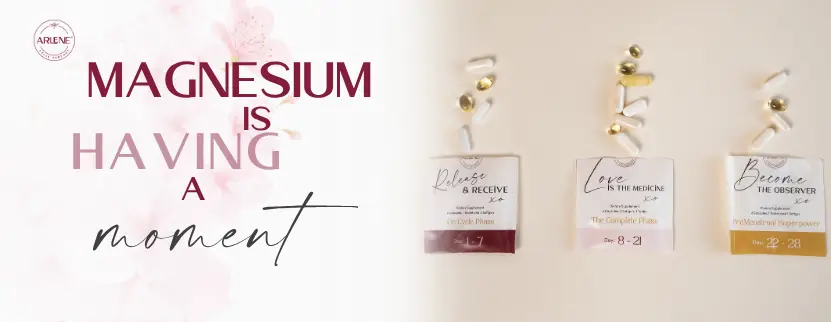
Days 1 to 7. The body is doing real work and often asks for rest, warmth, and slower pacing. This is a week to stop negotiating with yourself about productivity. Magnesium-rich food, an early night, and permission to do less are not indulgences here. They are the correct response.
Days 8 to 21. For many women this stretch carries steadier energy and clearer thinking. Support here is less about rescue and more about not squandering the window. Consistent meals, consistent sleep, consistent minerals. The goal is to sustain what is already working rather than wait for it to disappear.
Days 22 to 28. This is where magnesium’s moment gets most interesting for women. The final phase before a period is when so many women describe feeling more tender, more wired, more awake at 2am, and more inclined to snap at something that would not have registered a week earlier. This is the phase where the winding-down qualities everyone is talking about tend to matter most, and it is precisely the phase a one-size-fits-all daily dose was never designed around.
Same mineral. Very different week. That is the whole point.
Making It a Ritual, Not a Chore
The women who stay consistent are rarely the most disciplined ones. They are the ones who made it pleasant.
A magnesium-rich drink in the evening of your luteal week, made properly, in a nice glass, phone face down, is worth more than a supplement you resent taking. A Bougie Beverage in the days before your period is not a wellness performance. It is a small, deliberate signal to your body that the week ahead is going to be met with something other than white-knuckling.
Ritual is what turns support into something you actually keep doing.
Where Arlene Fits In
Arlene was built on the idea this article keeps circling. Your body’s needs change across the month, so your support should too.
That is why Arlene is not one formula. It is a phase-based system, designed so that the support you have on day three is not the same support you have on day twenty-four. Magnesium appears across the packs, thoughtfully placed rather than dumped in one identical daily dose and left to do everything.
The magnesium trend is right that the mineral matters. Arlene’s argument is that timing matters too.
The Trend Is Right. It Is Just Not Finished.
Magnesium deserves its moment. A trusted medical institution just spent a full article explaining why, and the intake gap is real enough that most women would benefit from paying attention.
But “take magnesium” is where the conversation starts, not where it ends. The next sentence, the one that actually changes how a month feels, is: when?
Once you know where you are in your cycle, you stop taking minerals at your body and start taking them with it.
Ready to support your cycle phase by phase? Explore Arlene and discover a more intentional way to meet every week of your month.