
Most women have had the moment. You feel off. Foggy, flat, more sensitive than usual, or suddenly wired at the wrong time of day. And the question quietly forms: is this my cycle, or is something else going on?
For a lot of women, the honest answer is that they simply do not know. And it turns out that is not a personal failing. It is remarkably common.
A new study published in the journal Menopause found that around one in three women were unsure of their own reproductive stage. Among women aged forty to forty-four, that number climbed to forty-two percent. The single biggest reason was not a lack of intelligence or attention. It was symptom confusion, the difficulty of telling normal hormonal shifts apart from stress, sleep, or everyday life. That was the leading driver at fifty-six percent.
Read that again. More than half of the women who felt uncertain about their bodies felt that way because their symptoms were so hard to interpret.
This is not a small thing. It means a huge number of women are moving through their month reacting to signals they were never taught how to read.
Why So Many Women Cannot Read Their Own Signals
We are handed very little real education about the female body. Most women learn that a period arrives, and not much else. The weeks in between, the shifts in energy, mood, focus, appetite, and sleep, are rarely explained as connected to anything.
So when clarity dips or the mood turns, the instinct is to look for a lifestyle reason. I did not sleep enough. I am too stressed. I am not disciplined enough. Sometimes those things are true. But often the body is simply moving through a phase, and no one ever named the pattern.
When you cannot name what is happening, everything feels random. And randomness is exhausting. It keeps you guessing, second-guessing, and bracing for a version of yourself you did not see coming.
The Cycle Has Phases, Not Just a Period
One of the most steadying things a woman can learn is that her cycle is not a single event. It moves through distinct phases, and each one tends to carry its own character.
In the days of menstruation, the body is doing real work and often asks for rest and slower pacing. In the middle stretch of the month, many women notice steadier energy, clearer thinking, and more ease in conversation and momentum. Toward the final phase before a period, energy often turns more inward, with a stronger pull toward quiet, routine, and recovery.
None of these shifts are a problem to be fixed. They are a rhythm to be recognized. And recognizing them is the difference between feeling ambushed by your own body and feeling like you understand it.
Why “Is It My Cycle?” Is Such a Powerful Question
The moment a woman starts asking whether a feeling is connected to her phase, something changes. She stops taking every hard day personally. She starts to see a pattern instead of a flaw.
That single question, asked with curiosity instead of frustration, is often the first step out of the monthly guessing game. It moves a woman from “what is wrong with me” to “where am I in my month, and what does my body need right now.”
The forty-two percent statistic is not a story about women being uninformed. It is a story about how little support women have been given to understand their own design. And it points to a real opportunity, because clarity is learnable.
How to Start Reading Your Own Rhythm
You do not need a perfect system to begin. You need attention and a little consistency.
Start by simply noticing. Track the first day of your period, and jot down a word or two each day about your energy, mood, and focus. Over one or two months, patterns tend to surface on their own. The heavy days, the clear days, the tender days start to line up in a way that finally makes sense.
Pay attention to sleep, meals, and stress alongside your phase, because they interact. A tired, under-fueled body will feel every phase more intensely. A supported one tends to move through the month with more ease.
And give yourself permission to plan around what you notice. Some phases naturally support output and connection. Others ask for softness and space. Working with that rhythm, rather than against it, tends to feel far kinder than forcing the same performance every single day.
Where Arlene Fits In
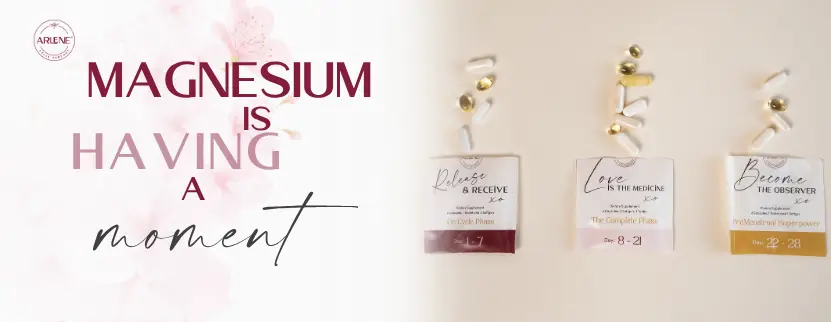
For women who want a more intentional way to move through the month, Arlene was built around a simple idea: your body’s needs are not the same on day three as they are on day twenty. The phase-based approach is designed to help you feel supported through the changing energy, focus, and comfort of each part of your cycle, so that once you understand the phase you are in, you have something thoughtful to meet it with.
Understanding your rhythm is the first step. Supporting it, phase by phase, is the next.
You Were Never Behind. You Were Never Taught.
If you have spent years unsure whether a feeling was your cycle or something else, you are in very good company. A third of women feel exactly that uncertainty, and among women in their early forties, it is close to half.
The answer was never to try harder to control your body. It was to learn to read it. And that is something any woman can begin, starting with a single question on a single ordinary day.
Is this my cycle, or something else? Once you can answer that, the whole month starts to feel less like a mystery and more like your own.
Ready to move through your month with more clarity? Explore Arlene and discover a more intentional way to support every phase.